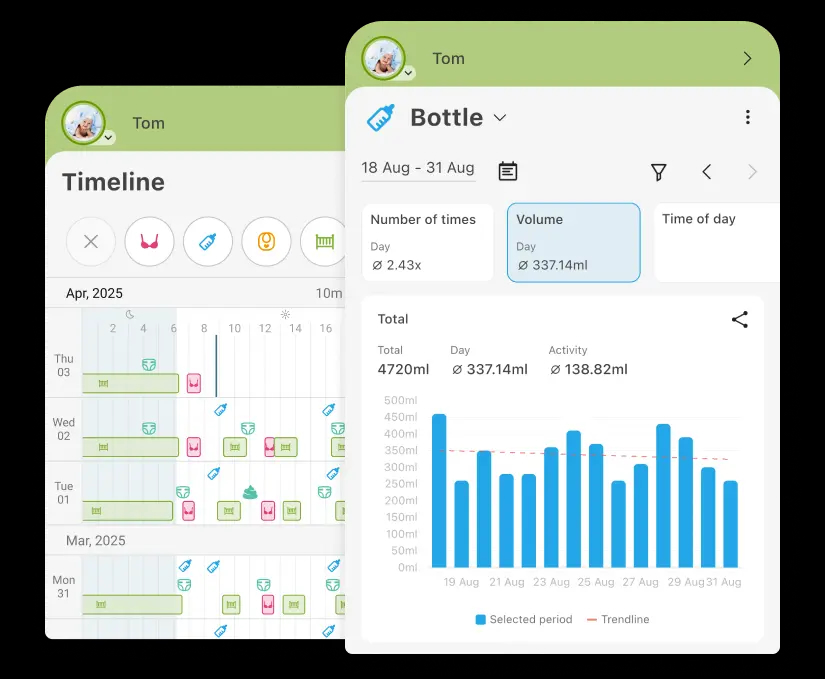

My first grandson just turned one year old! Watching him grow and develop has been a fascinating masterclass in human physiology. And watching my daughter track every milliliter of milk and every minute of sleep on an app for the first several months really got me thinking.
As an evidence-based nutritionist who lives and breathes macros, I’m often met with the “anti-tracking” crowd. You know the ones — they claim that counting grams or tracking numbers is “unnatural,” “contrived,” or “too complicated” for people who just want to eat better. Instead, they say, just eat intuitively or use your instincts.
But here’s the kicker:
We don’t apply that ‘instinct-only’ logic to the most vulnerable humans on the planet — those with the most critical need to thrive, rather than just survive.
If you’re wondering why temporary, short-term tracking is the secret weapon to moving from surviving to thriving, look no further than the newborn nursery.
The “Why” Behind the Baby Apps
New parents aren’t just being “Type A” with those apps. There is robust, clinical evidence for why we monitor a newborn’s intake so rigidly in the beginning:
Instincts are Loud, but Inaccurate:
We assume babies “know” when they’re hungry. But newborns often don’t have clear hunger cues yet. They might be too sleepy to wake up for a feed, or they might cry from overstimulation, not hunger. By the time a baby is screaming, they are in “late-stage” hunger—which makes for a frantic, poor-quality feeding.
The “Survival” Buffer:
A newborn’s stomach is tiny (about the size of a marble at birth), and their metabolic rate is sky-high. If they miss a single feeding because they “didn’t seem hungry,” their blood sugar can drop, making them even sleepier and less likely to eat. We track to ensure they stay on the growth curve, not just to keep them alive.
Data Beats Guesswork:
Pediatricians don’t ask, “Does the baby seem happy?” They ask, “How many ounces/minutes and how many wet diapers?” Why? Because data is the only objective way to diagnose a “failure to thrive” before it becomes a crisis.
Adults: We’re Just “Big Babies” with Worse Habits
Here is the uncomfortable truth:
Most adults have far less instinctual cues than newborns.
Between the 24/7 access to hyper-palatable processed foods, the stress of a 10-hour workday, and the “loopiness” of late-night habits, our “hunger” and “fullness” cues are completely haywire.
- We eat because we’re bored.
- We skip meals because we’re “busy,” only to ravenously overeat at 8:00 PM.
- We underestimate our intake by 30-50% (a statistical fact in nutritional science).
When someone tells me tracking is “too much work,” I think of that newborn. We track the baby to establish a baseline, to identify patterns, and to ensure optimal growth.
The “Temporary” Power of the Log
I’m not saying you need to track your macros for the rest of your life. Even for babies, the hyper-vigilant tracking eventually fades as they establish a healthy weight and predictable rhythm.
But for an adult trying to build an efficient and thriving metabolism, or create solid new eating habits –
Temporary tracking is your diagnostic tool.
- It bridges the gap between perception and reality.
- It recalibrates your internal “Appestat.” You learn what 30g of protein actually looks like so you can eventually eyeball it with confidence.
- It moves you from “Surviving” (just getting through the day) to “Thriving” (having the energy to actually enjoy it).
The Bottom Line
If we don’t trust a brand-new human to “instinctively” manage their survival without data, why do we think an adult — carrying decades of physiological “noise” and unhealthy habits — can magically intuit their way to optimal eating?
If you want to thrive, put down the “instinct” excuse for a few weeks and pick up the data. If it’s good enough for a newborn baby, it’s good enough for all of us.
Ready to learn more about macro-based eating and how it can give you the baseline you need to successfully eat intuitively for the rest of your life? Reach out anytime, this is my jam 😊

The entire contents of this website are based upon the opinions of Build Holistic Nutrition. Please note that Build Nutrition is not a dietitian, physician, pharmacist or other licensed healthcare professional. The information on this website is NOT intended as medical advice, nor is it intended to replace the care of a qualified health care professional. This content is not intended to diagnose or treat any diseases. Always consult with your primary care physician or licensed healthcare provider for all diagnosis and treatment of any diseases or conditions, for medications or medical advice, as well as before changing your health care regimen.

© BUILD NUTRITION 2026. ALL RIGHTS RESERVED. PRIVACY POLICY



Go ahead, creep us on social. You know you want to!