

Blog Contents:
- If you choose to use numbers, you should be able to trust them
- Physiologically Implausible: Why I Quit Whoop
- Understanding the Science of the Numbers
- How Accurate are the Formulas?
- Why is Whoop so far off?
- My Transition to Garmin: Finding Congruence
Let’s just set the record straight first up –
Counting calories, tracking macros, or otherwise living by numbers for the rest of your life is neither a desired goal of mine, nor one I advocate to my clients. However, as a nutritionist, I often propose a temporary period of ‘dialing in’ — a season of tracking that isn’t about lifelong obsession or nutritional perfectionism, but about building a permanent foundation of metabolic knowledge to help guide your nutrition choices and support your health and/or fitness goals.
The core of the issue we’re about to dive into isn’t about being ‘obsessed’ with metrics for the rest of your life; it’s about ensuring that when you do decide to look under the hood of your own physiology, the data staring back at you is accurate enough to actually empower your progress.
I also want to be clear that I think Whoop is a remarkable piece of technology and it remains a powerful contender in the wearable space. As a nutritionist, it just didn’t align with my ‘North Star’ of clinical caloric accuracy – and in this blog, I share my ‘why’.

If you choose to use numbers, you should be able to trust them.
As an evidence-based, fitness-focused nutritionist, I love numbers! My career is built on the objective reality of human physiology — calories, macros, micros (real food nutrients), and the gritty data of metabolism. I don’t deal in ‘vibes’ or ‘guesses.’ I deal in data and in biofeedback — that is, where the algorithm meets the actual human experience.
I realize this level of metabolic detail can feel like a lot of technical ‘noise’ to the uninitiated. Not everyone needs — or wants — to track their daily calorie burn to the exact decimal point, and a highly analytical approach to wellness isn’t a requirement for health.
However, if you’ve strapped a fitness tracker to your wrist, you probably aren’t doing it for fashion. You’re doing it to access objective, science-based data.
Physiologically Implausible: Why I Quit Whoop
For a long time, I wore a Whoop strap because I loved the promise of it: deep sleep insights, HRV tracking, daily steps and calorie burn. But I reached a point where the calorie/energy expenditure data was so consistently, clinically implausible that I could no longer justify paying for a subscription that felt like it was gaslighting me about my own metabolism.
I think my most recent email to Whoop support sums it up.
__________________________________________________
Dear WHOOP Support Team,
I am writing to follow up on a concern I have previously raised regarding the apparent underestimation of total daily calorie burn within the WHOOP app. Unfortunately, this issue continues to persist and remains concerning to me. I can see on the Whoop community message board that it is also a concern for many others.
I’m a highly active former competitive athlete, and a fitness and nutrition professional who works closely with many individuals who are also WHOOP users. A recurring theme among fit users is that total daily energy expenditure appears to be significantly underestimated — particularly in those with low resting heart rates, efficient cardiovascular systems, and rapid heart rate recovery.
I understand that WHOOP’s algorithm relies heavily on heart rate–based estimations. However, in very fit individuals — this appears to lead to disproportionately low total calorie burn estimates.
As an example, here are two very recent days of my Whoop tracking:
Feb.28, 2026:
- 2 hours walking
- 30 minutes spin
- 1 hour weightlifting
- 30 minutes Crossfit/box fitness
- 30 minutes pickleball (hard singles)
- Total 4.5 hours of intentional activity
- WHOOP steps 25,329
- WHOOP strain score of 16.6
- WHOOP reported total calorie burn for this day: 1755
March 1, 2026:
- 1:50 hour walking
- 30 minutes hard spin
- 35 minutes weightlifting
- Total 3 hours of intentional activity
- WHOOP steps 20,325
- WHOOP strain score of 12.5
- WHOOP reported total calorie burn for this day: 1554
Using the Harris-Benedict or Mifflin-St Jeor BMR formula (ones that do not account for muscle mass) my BMR is estimated at 1180-1270 calories. The Cunningham/Katch-McArdle method, which does take into account muscle mass, puts me at a BMR of about 1440 calories. Whichever you use, WHOOP’s reported total daily calorie burn on these high activity and high strain days seem physiologically implausible.
Additionally, I periodically track my caloric intake accurately for professional and personal purposes. My average intake is consistently well over 2,000 calories per day, sometimes 2500 calories or more. If the WHOOP-reported calorie expenditures were accurate, I would be in a substantial daily caloric surplus and would clearly be gaining weight over time. This is not the case. My weight and body composition remain stable, which further suggests that the reported total daily energy expenditure is significantly underestimated.
I fully acknowledge that all predictive equations are estimates and not exact measures. I also recognize that individual variance can be meaningful. However, even allowing for a margin of error of up to 20% in BMR estimation, this would not account for a discrepancy of several hundred calories per day, particularly on high-activity days such as the ones described above.
It seems reasonable that total daily calories burned calculations could be improved if incorporated:
- A validated BMR estimate that takes into account muscle mass (if user data is available)
- Plus reported activity load
- Rather than relying predominantly on heart rate response
While I understand that calorie metrics are not intended to serve as precise dietary prescriptions, for many users who implicitly trust the Whoop technology, this is a key data point they use. Many users do rely on this number to guide intake decisions. Significant underestimation — especially in active individuals — could unintentionally encourage chronic under-fueling, which carries potential health and performance risks.
I would love to know:
- Whether this concern has been formally reviewed by your product or data science teams
- Whether algorithm refinements are being considered for highly fit populations
- If there are user-specific adjustments that may improve accuracy
I truly value WHOOP’s recovery and strain insights and would very much like to see the calorie expenditure metric better reflect real-world physiology — particularly for well-trained individuals.
Thank you for your time and consideration. I look forward to your response.
__________________________________________________
I did not receive a response to this email. Responses to my previous inquiries followed a predictable script: stating how their proprietary algorithm relies almost exclusively on heart rate, instructions on how to adjust my wristband for “improved accuracy” in measuring my heart rate, and skirting around the issue of how their numbers are in direct contrast to globally trusted BMR formulas.
Let’s talk about those formulas to really understand the issue here.

Understanding the Science of the Numbers
To accurately estimate human energy needs, metabolic science relies on Basal Metabolic Rate (BMR) formulas. Developed and validated by decades of peer-reviewed research from PhDs and exercise physiologists worldwide, these equations — such as the Mifflin-St Jeor or the Katch-McArdle — provide a clinical “floor” for your metabolism. They calculate the number of calories your body requires to maintain basic life-sustaining functions (like cellular repair and organ function) in a state of complete rest.
These formulas are not guesses; they are universally accepted mathematical models that account for age, biological sex, and weight. More advanced versions specifically incorporate skeletal muscle mass as well – recognizing that muscle is a metabolically active tissue that burns more energy than fat, even at rest.
Beyond just keeping your organs functioning (your BMR), your body also burns calories in other key ways.
Thermic Effect of Food (TEF):
- The energy your body uses to digest and process what you eat typically accounts for approximately 10% of your total daily calorie expenditure. For a person expending 2,000 calories a day, about 200 of those calories are burned simply through the process of eating and processing food.
- While 10% is the standard average, the actual amount of energy burned can vary significantly based on what you eat.
- Protein: Has the highest effect, requiring 20% to 30% of its own caloric content for digestion (in part why increasing protein supports weight loss).
- Carbohydrates: Require roughly 5% to 15%; complex carbs and high-fiber foods sit at the higher end of this range.
- Fats: Have the lowest effect, requiring only 0% to 5% (some estimates go up to 10%) of their caloric energy to process.
- Lastly, minimally processed whole grains and whole foods generally increase TEF compared to highly refined or processed foods.
Lifestyle Movement (NEAT):
- The energy you burn from normal daily movement — excluding structured exercise — is known as Non-Exercise Activity Thermogenesis (NEAT). It includes every single bit of activity from walking to the kitchen to weeding your garden. It all burns energy, above and beyond your BMR.
- For the average person, NEAT typically accounts for approximately 15% of total daily energy expenditure. Depending on how much you move throughout the day, the caloric impact of NEAT can range significantly.
- Sedentary Lifestyles: In individuals who spend most of the day sitting, NEAT may account for only about 6% to 10% of total energy burn.
- Highly Active Lifestyles: For those with physically demanding jobs or high levels of daily movement (ie: the energizer bunny like myself who never sits still!), NEAT can rise to 50% or more of total daily energy expenditure.
- Caloric Range: In absolute terms, the difference between a sedentary person and an active person can be as much as 2,000 calories per day, even if their body sizes are similar. Take away: never underestimate how powerful movement is through your day!
Intentional exercise (EEE):
- Exercise energy expenditure (EEE) includes your gym workouts, spin sessions, and all other intentional sweaty heart-rate increasing activities you do. This actually burns a lot less than you probably think. For example, in a gruelling one-hour workout, I might only burn about 400 calories, or less than 20% of my total daily calories. But don’t be discouraged! Working at higher intensities and building muscle – both increase the amount of calories your body burns after the workout, while at rest (thereby increasing your BMR). Exercise is a long game!
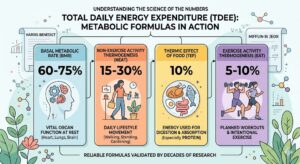
The typical breakdown of TDEE (Total Daily Energy Expenditure):
- BMR (60%–75%): The energy for vital organ function at rest.
- NEAT (~15%+): Non-exercise activity like gardening or walking to the kitchen.
- TEF (~10%): The energy used to digest protein (20-30%), carbs (5-15%), and fats (0-5%).
- EEE (5%–10%): Planned, intentional exercise.
How Accurate are the Formulas?
Even the best scientific formulas carry a margin of error — typically around 10% to 20%. It’s said that most validated BMR formulas (like Mifflin-St Jeor) are accurate within 10% for about 80% of the population. Once you add on the other things that burn energy/calories (lifestyle movement and exercise), the variance naturally increases because tracking technology has its own margin of error.
Most practitioners agree that a 20% variance is a realistic “buffer” to suggest for TDEE. This variance is exactly why it is so critical to start with a tracker that uses validated, peer-reviewed basal metabolic rate formulas to begin with (the foundation) – because the margin for error only gets larger when we layer on the NEAT, TEF, and EEE.
When your device starts with a baseline number that is already 20% or more off at rest, and then under-estimates activity on top of that, the resulting data becomes unusable for anyone serious about fueling for health and performance – which for many people, is exactly why they’re using these trackers in the first place!
Why is Whoop so far off?
The Physiological Paradox: Heart Rate vs. Metabolism
As Whoop states, their algorithm operates primarily on heart rate (HR). So if your HR isn’t sustained in a high-intensity workout zone, if you have a low resting heart rate or a rapid recovery, Whoop essentially stops counting. This is a catastrophic flaw for fit individuals with high cardiovascular efficiency.
For example, yesterday I went for a one hour brisk walk. Not a high intensity sweaty workout – but my heart rate throughout was well above my low resting HR of about 55 bpm (beats per minute). It was close to 100 bpm for the duration of the walk . Whoop reported a total burn of 55 calories for that hour. Garmin reported 158. Which one is more accurate?
Well… given that my BMR is 1440 calories – if we loosely calculate therefore that my average per-hour at-rest burn is about 60 calories… How could I have burned less than that while NOT resting, while walking briskly? I’m gonna go with Garmin on this one.
Here’s the reality: Metabolism is not a heart rate monitor.
By relying predominantly on heart rate response, Whoop is not only dismissing expertly developed and globally trusted metabolic equations, but is disregarding movement that does not increase the heart rate up into what they consider ‘work’. This is not only scientifically reductive — reducing the complexity of human metabolism to a single heart-rate variable — but as a nutritionist, I believe it is potentially dangerous.
Right or wrong, many users implicitly trust this technology to guide their intake decisions. When a device tells a highly active woman she’s only burned 1,500 calories in a day with over 3 hours of activity, it inadvertently encourages chronic under-fueling. This isn’t just about a missed metric; it’s about the potential for metabolic damage, performance risks, and hormonal health issues.
My Transition to Garmin: Finding Congruence
My transition to Garmin was driven by a desire for energy-expenditure data that aligns with clinical observation. I won’t get into all the reasons I chose Garmin over Fitbit or Apple to switch to (I’m sure you’ll do your own research!), but I will tell you that the sleep, stress/strain, steps, and recovery markers provided by Garmin so far are pretty close to Whoops. The big difference, of course, is the daily calorie/energy burn.
Garmin’s methodology respects established metabolic science by utilizing validated BMR as a foundation. Additionally, rather than relying exclusively on heart rate fluctuations, it layers active movement — including steps and mechanical load — onto that baseline. This multi-factor approach acknowledges that 16,000+ steps represent a significant metabolic cost, regardless of how efficiently the cardiovascular system handles the effort.
At the time of writing this, I’ve been wearing both my Whoop and my new Garmin for about a week, for comparison. So far, here’s what I’ve observed:
- Even on a rest day, my Garmin reported burn is much closer to my calculated BMR + NEAT; aligning with the known formulas.
- When I am active and exercising, Garmin’s reported calorie burn is anywhere from 2-3x what Whoop suggests for the same activity.
- My end of the day total calorie burn has been anywhere from 300-850 more calories/day on Garmin than Whoop. My average daily Whoop burn in the last week was 1532 calories (despite anywhere from 1-4 hours of activity/exercise each day). Garmin’s daily average in this same week was 2000 calories – a number that matches my real life biofeedback. That is, I regularly consume about 2000 calories or more daily, and I am weight stable – neither losing or gaining – as a result.
This isn’t just about Garmin having “better” numbers; it’s about a fundamental shift in trust.
My move from Whoop to Garmin was ultimately a search for congruence. As a nutritionist who teaches others how to fuel optimally, it’s important to me that a device shows energy expenditures that align not just with established science, but also with the clinical reality of one’s body.
In my practice, I tell my clients that a wearable should be a compass, not a cage. If a client’s wellness, weight stability and caloric intake are pointing in one direction, but their tracker is pointing in another, that tool has become a hindrance rather than a help.
I didn’t quit Whoop just because I’m obsessed with numbers 🤓; I quit because I value the integrity of the data I use to navigate my own and my clients’ nutrition and progress. I chose Garmin because it offered an authentic intersection where science-based algorithms actually meet real-world human physiology. Professionally and personally, there is an immense sense of security in finding that alignment.
Is Whoop Right for You?
Despite my move to Garmin, I want to be clear: Whoop is a remarkable piece of technology. For many, its focus on recovery, sleep hygiene, and strain is exactly the high-level coaching they need to optimize their performance. If those are the metrics that move the needle for you, Whoop remains a powerful contender in the wearable space.
However, as a nutritionist, my ‘North Star’ will always be the integrity of energy expenditure data. Because my practice is so heavily rooted in these validated formulas that govern human nutrition, the discrepancy in calorie tracking was a bridge too far from my personal and professional needs.
I invite you to explore the metrics that matter most to your own journey — whether that is recovery scores, step counts, or caloric precision — and choose the tool that offers you the most congruence. After all, the best tracker isn’t the one with the most features; it’s the one that gives you the information and inspiration to move you forward in your fitness and wellness journey.

The entire contents of this website are based upon the opinions of Build Holistic Nutrition. Please note that Build Nutrition is not a dietitian, physician, pharmacist or other licensed healthcare professional. The information on this website is NOT intended as medical advice, nor is it intended to replace the care of a qualified health care professional. This content is not intended to diagnose or treat any diseases. Always consult with your primary care physician or licensed healthcare provider for all diagnosis and treatment of any diseases or conditions, for medications or medical advice, as well as before changing your health care regimen.

© BUILD NUTRITION 2026. ALL RIGHTS RESERVED. PRIVACY POLICY



Go ahead, creep us on social. You know you want to!