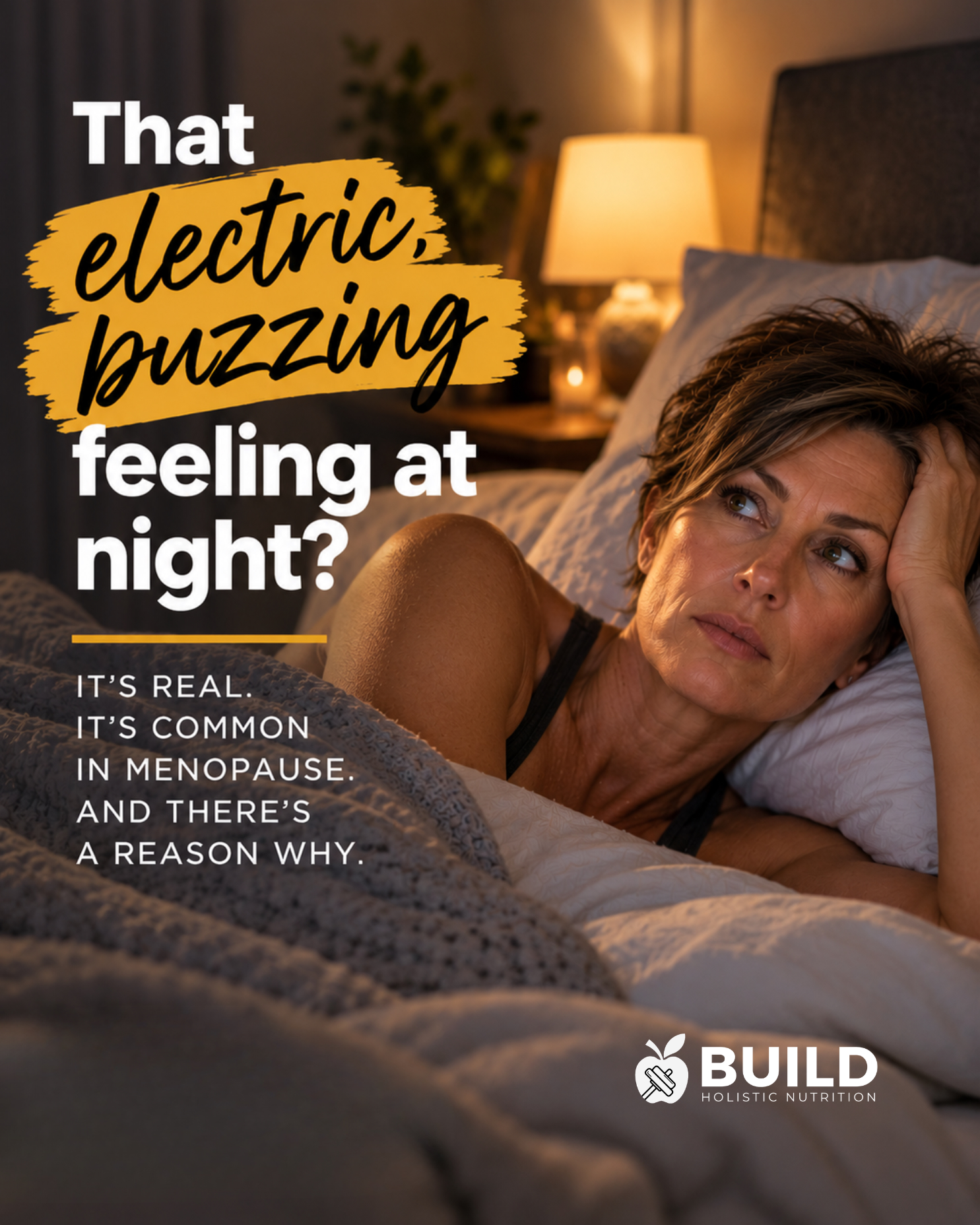

Some nights, it feels like someone has plugged my body into an outlet.
It isn’t pain. It isn’t worry. It’s a buzzing, electric feeling running through my whole body, and every position I try feels wrong within seconds. I’m jolted to move, again and again, like a compulsion I can’t switch off.
If that sounds familiar, you’re not imagining it. This whole body surging with electricity feeling is real, and there’s actual science behind why this sometimes happens in peri/post menopause – even if, like me, you’ve been a great sleeper your entire life up until now.
This isn’t aches and pains. It’s a nervous system that won’t settle.
What menopause does to your nervous system
Estrogen isn’t only a reproductive hormone. There are estrogen receptors throughout your brain and nervous system, and estrogen helps influence the chemical messengers that keep nerve signalling in balance, including:
- GABA: your calming, “slow down” messenger.
- Glutamate: your excitatory, “fire” messenger.
- Serotonin and dopamine: messengers involved in mood, sleep and movement.
When estrogen drops through perimenopause and post-menopause, that balance can shift. Many women feel it as a nervous system that is more reactive and harder to calm.
Tingling, crawling, burning and electric-shock sensations are recognized menopausal symptoms. Researchers are still working out exactly why they happen, but changing hormones and a more easily aroused nervous system are leading explanations.
Why it hits at night
Lying still in a quiet, dark room removes every distraction, so internal sensations get louder. There’s a biological piece too:
Dopamine follows a daily rhythm.
Its signalling tends to dip in the evening and overnight, which is why restless, jolting sensations typically peak at night.
Stress hormones can spike in the night.
Cortisol and adrenaline surges can wake you and leave you feeling wired and braced.
Blood sugar matters.
A late-night dip can trigger a stress-hormone response that wakes you up, which is one reason I care so much about steady blood sugar through the day.

Is it restless legs, or something else?
This is the part that surprised me most. I already have restless legs syndrome (RLS) – another menopause gift – and I assumed this was a separate “nerve thing”. It may not be.
RLS is more common in women, and many notice it changing around perimenopause and menopause. It isn’t always limited to the legs, either. For some people the creepy-crawly, electric, must-move feeling spreads to the arms, torso or even the whole body, and it’s typically worse when you’re lying still at night and eased by moving.
That description fits what I feel almost exactly. So the question isn’t only whether this is menopause or RLS. Hormonal change may be making RLS-type symptoms stronger and more widespread.
What else to rule out
Tingling and restlessness at night have more than one possible cause, so it’s worth asking your healthcare provider to check:
Ferritin (your iron stores).
Low ferritin is strongly linked to RLS, and specialists often aim for higher levels than the standard lab “normal”. Please don’t start iron on your own, because too much iron isn’t harmless, especially once you’re no longer menstruating.
Vitamin B12.
Low B12 can cause tingling and nerve sensations.
Thyroid function.
Ask for the full picture, not only TSH. T3 and T4 are the actual thyroid hormones that do your metabolic work in the body, and can often be out of range even when TSH is normal.
Blood sugar and insulin.
Glucose and insulin issues can affect nerves and sleep.
Your medications and habits.
Many over-the-counter antihistamine sleep aids, some antidepressants, caffeine and alcohol can all make restless sensations worse.
What can help in the moment
When you’re in the middle of one of these nights, fighting it in bed usually makes it worse. These are the practical things that many women find help:
Get out of bed.
If you’ve been awake and jolting for about 20 minutes, move to a dim, cool room and do something calm until it settles.
Move gently.
Slow walking, a child’s pose or a hamstring stretch gives your nervous system another signal to focus on.
Change the temperature.
A warm shower or bath, or a cool pack on the back of your neck, works for many people.
Try massage or pressure.
Rubbing or pressing the area can quiet the sensation for some.
These “counter-stimulation” tricks are commonly suggested for RLS. They won’t fix the cause, but they can take the edge off. Ibuprofen and other anti-inflammatories won’t help with this kind of nerve sensation, since it isn’t driven by tissue inflammation.
Where medication fits
Gabapentin is one option that’s used for RLS, and it’s also prescribed off-label for hot flashes and sleep disruption in menopause. It works by dampening overactive nerve signalling.
Here’s what’s worth knowing:
It isn’t an instant fix.
It takes a few hours to reach its peak in your body, and the benefit comes from consistent use, so timing matters.
It has side effects.
Drowsiness, dizziness and fluid retention are among the most common, and it’s important not to stop it suddenly.
The dose and timing are a conversation with your prescriber.
Please don’t adjust your own.
Some women also ask whether menopausal hormone therapy could help their sleep and nervous system symptoms. That’s a question for your doctor, but I can tell I am on HRT (for several years now) and still have this sleep issue.
If your symptoms are new, one-sided, come with weakness or numbness, or are getting worse, please see your doctor promptly.
Don’t panic: start with the foundations
That was a lot of science. The good news is that the daily habits that steady your hormones and your nervous system overlap with the ones I talk about all the time:
- Getting 7 or more hours of sleep.
- Limiting alcohol, which fragments sleep and affects cortisol.
- Getting outside for daylight and gentle movement.
- Eating enough protein and keeping blood sugar steady through the day.
- Avoiding a late-night snack crash by fuelling well earlier in the day.
In RxGRIT, these are some of the 10 daily actions that target the hormonal and metabolic changes of menopause, with the daily nudges, tips, and accountability to keep doing them.
Try RxGRIT free for 7 days at rxgrit.buildnutrition.ca/signup.

Disclaimer: This information is for general knowledge and should not be taken as medical advice. Always consult with a healthcare provider before starting any new supplement or health regimen, and before changing any medication.

The entire contents of this website are based upon the opinions of Build Holistic Nutrition. Please note that Build Nutrition is not a dietitian, physician, pharmacist or other licensed healthcare professional. The information on this website is NOT intended as medical advice, nor is it intended to replace the care of a qualified health care professional. This content is not intended to diagnose or treat any diseases. Always consult with your primary care physician or licensed healthcare provider for all diagnosis and treatment of any diseases or conditions, for medications or medical advice, as well as before changing your health care regimen.

© BUILD NUTRITION 2026. ALL RIGHTS RESERVED. PRIVACY POLICY



Go ahead, creep us on social. You know you want to!